Waking up exhausted after spending eight hours in bed is one of the most frustrating experiences in modern life. You didn’t stay up late, you didn’t look at your phone before sleeping, yet your eyelids feel heavy, and your brain feels trapped in a thick fog.
The truth is, sleep isn’t a continuous block of time where your brain simply switches off. It is a highly complex, rhythmic cycle. If your alarm goes off at the wrong physiological moment, you will face morning fatigue, regardless of how long you rested.
By understanding your internal biological patterns and utilizing a data-backed sleep calculator online, you can align your habits with your body’s natural needs. This comprehensive guide breaks down how to calculate your ideal bedtime, manage your internal clock, and use data points tailored to your demographic.
Demographics Matter: Sleep Calculator by Age and Gender
Sleep architecture is not one-size-fits-all. A toddler’s neurological recovery needs are completely different from a corporate executive’s or a senior citizen’s. This is why generic tools fail—they don’t account for developmental or hormonal variations.
Useful AI Sleep Calculator
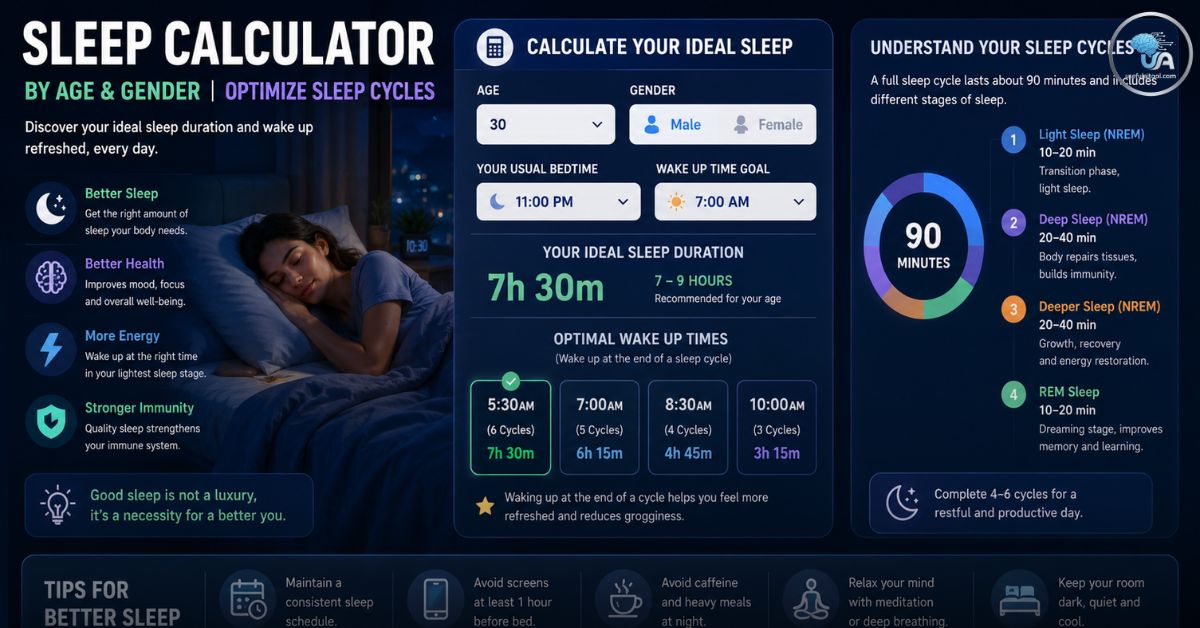
Calculate the perfect bedtime or wake-up slots using natural 90-minute sleep cycles.
Using a personalized sleep calculator by age and gender allows you to refine your calculations based on real biological baselines:
The Impact of Age
- Toddlers & Children: Their brains are rapidly developing, requiring anywhere from 10 to 14 hours of daily sleep. Their internal processing engine automatically schedules longer, more frequent cycles.
- Teenagers: Melatonin (the sleep hormone) is naturally secreted later in the evening for teens. They require roughly 8 to 10 hours of rest, shifting their ideal windows forward.
- Adults: The clinical gold standard sits between 7 and 9 hours of total rest per night.
- Seniors: As the human body ages, deep sleep stages naturally shorten, and sleep schedules become lighter and more fragmented, dropping the baseline requirement closer to 7 hours.
The Impact of Gender and Physiology
Neuro-metabolic studies indicate that adult females generally benefit from an average of 20 minutes of extra deep rest compared to males to achieve full cognitive recovery. Furthermore, during stages like pregnancy, spikes in progesterone can dramatically increase baseline exhaustion, shifting the ideal cycle target to its upper limit to support the body’s added workload.
Breaking Down the Sleep Calculator Cycle
To understand how to time your mornings, you must understand the sleep calculator cycle. Human sleep is divided into sequential 90-minute waves ($1.5\text{ hours}$).
A complete cycle consists of four distinct stages:
[Stage 1: Light Sleep] ➔ [Stage 2: Deeper Transition] ➔ [Stage 3: Deep Slow-Wave Sleep] ➔ [Stage 4: REM Sleep]
When you first close your eyes, you drift through light sleep stages where you can be easily awakened. Eventually, you plunge into Stage 3, or slow-wave deep sleep. This is where your body repairs muscles, strengthens its immune system, and builds tissue.
Also Try this Tool: The Ultimate Guide to AI Tattoo Design: Stencils Made Easy
If your alarm forces you awake while you are trapped in the middle of deep slow-wave sleep, your brain experiences Sleep Inertia. This causes heavy grogginess, spatial disorientation, and mental sluggishness that can last for hours.
The goal of our calculation engine is to ensure your alarm sounds precisely at the end of a completed 90-minute wave, when you are floating in your lightest phase of rest.
The Role of the Sleep Calculator REM Phase
The final stage of every 90-minute wave is REM (Rapid Eye Movement) sleep. If deep sleep is for body restoration, the sleep calculator rem phase is the ultimate tune-up for your mind.
During REM sleep, your brain waves mirror your awake state. This is where vivid dreaming occurs, information is processed, and your experiences are converted into long-term memories.
Interestingly, your first REM phase of the night lasts only a few minutes. However, as the night goes on, your deep sleep phases shorten, and your REM windows expand. By the time you reach your 5th or 6th consecutive cycle, you are spending a significant chunk of time in REM. Cutting your sleep short skips these critical morning REM windows, directly damaging your emotional regulation, focus, and creative performance the next day.
Step-by-Step: How to Use the Useful AI Sleep Calculator
Getting your customized sleep schedule matrix takes less than 30 seconds. Follow these simple instructions to find your ideal routine:
- Step 1: Set Your UI Aesthetics: Look at the top right corner of the calculator workspace. Click the toggle to switch between Light Mode or Dark Mode to match your current screen preferences.
- Step 2: Input Age & Gender Data: Select your current age bracket and your biological profile from the drop-down selectors. This tells the system how many total cycles to recommend.
- Step 3: Pick Your Calculation Pathway: * If you have a strict wake-up time for work or school, click “I want to WAKE UP at…” and select your exact time.
- If you are heading to bed right now, click “If I GO TO BED now…”.
- Step 4: Analyze Your Cards: Click Calculate Ideal Times. The engine will automatically factor in a standard 14-minute buffer (the average time it takes a human to fall asleep) and output custom cards showing your optimal bedtime or wake-up windows. Green cards indicate optimal, complete cycles.
How Much Sleep Did I Get?
If you wake up feeling rough and find yourself asking, “sleep calculator how much sleep did i get” to figure out what went wrong, you can use the calculation formula manually to audit your night.
If your total cycles end in a clean whole number (e.g., exactly $5.0$ or $6.0$ cycles), you likely woke up naturally and feel great. If your calculation reveals a fraction like $4.3$ or $5.2$ cycles, it means your alarm abruptly cut off a deep sleep phase, explaining your morning exhaustion.
FAQs on Sleep Calculator by Age & Gender
Q: Is sleeping for exactly 8 hours a myth?
A: Yes, for many people. Eight hours equals 480 minutes. If you divide 480 by 90 minutes, you get $5.33$ cycles. Waking up at $5.33$ cycles means you are cutting right into your 6th deep sleep wave. For most adults, sleeping for 7.5 hours (exactly 5 cycles) or 9 hours (exactly 6 cycles) results in a much fresher morning than forcing an arbitrary 8-hour window.
Q: Why does the tool include a 14-minute buffer?
A: In sleep medicine, this is known as Sleep Latency. Healthy individuals rarely fall asleep the exact second their head hits the pillow. Medical consensus shows it takes an average of 10 to 20 minutes to transition from wakefulness to light sleep. The calculator uses a 14-minute baseline to ensure your cycles align perfectly with actual sleep, not just time spent lying in bed.
Q: Can I catch up on lost sleep cycles over the weekend?
A: Unfortunately, your circadian rhythm doesn’t work like a bank account. You cannot accumulate a “sleep debt” during the week and pay it off on Sunday. Sleeping in excessively on weekends disrupts your internal clock, a phenomenon known as “social jetlag,” which makes it even harder to fall asleep on Sunday night. Consistency is far more valuable than raw volume.
Summary: Master Your Circadian Rhythm
Beating morning fatigue isn’t about sleeping longer; it’s about sleeping smarter. By shifting your perspective from total hours to structured 90-minute sleep waves, you align your routine with your body’s natural biology.
Ready to eliminate morning grogginess for good? Open up the Useful AI Sleep Calculator framework above, select your age and gender markers, and find the perfect, personalized sleep window that works for you.