
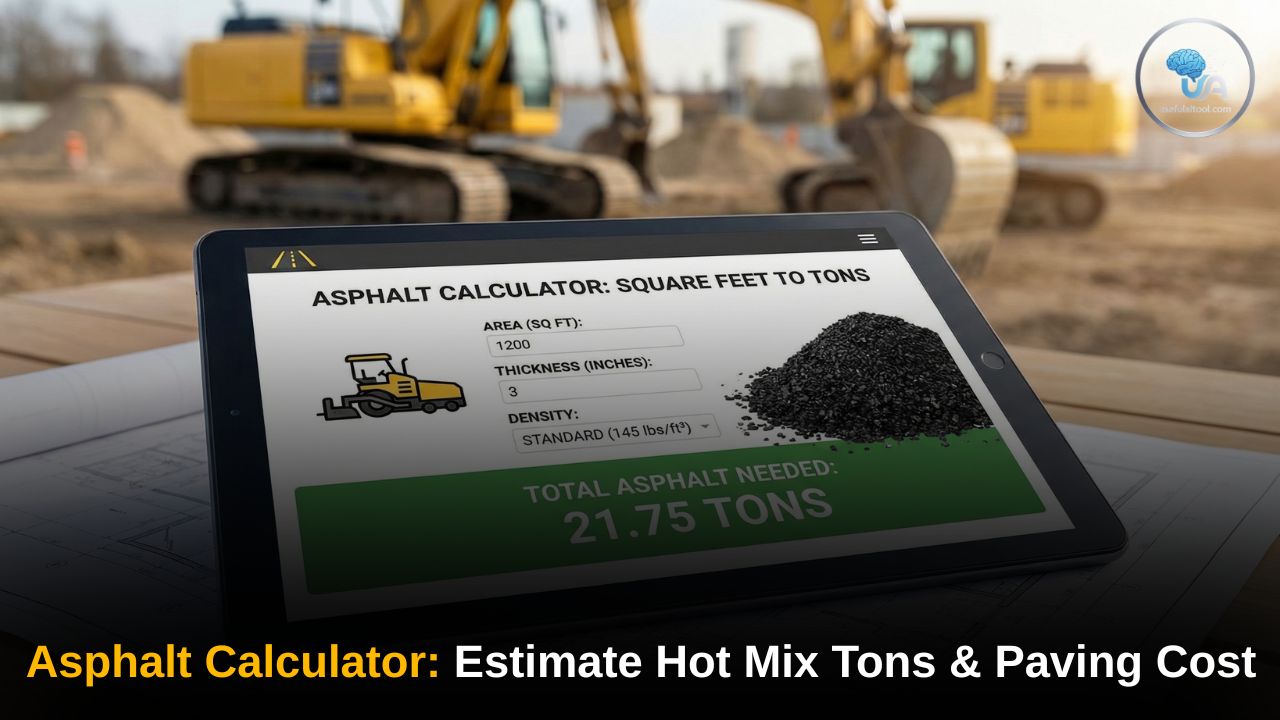
When planning a paving project, the most confusing part is usually the math. You measure your driveway or parking lot in square feet, but the asphalt plant sells the material in tons. This mismatch often leads to calculation errors, wasted money, or—worst of all—running out of material halfway through the job.
If you are looking for a reliable asphalt calculator square feet to tons conversion tool, you are in the right place.
Our free tool above bridges the gap between your measurements and the supplier’s requirements. Whether you are paving a small residential driveway or a massive commercial lot, this guide will help you determine exactly how much hot mix asphalt you need.
Why You Need an Asphalt Calculator (Square Feet to Tons)
Why can’t you just buy asphalt by the truckload without calculating?
- Precision Saves Money: Asphalt prices in 2026 range from $80 to $120 per ton. Overestimating by just 2 tons can cost you over $200.
- Preventing Cold Joints: If you underestimate and run out of material, the first section will cool down before the new truck arrives. This creates a “cold joint,” which is a weak seam that will crack and fail quickly.
- Density Variance: Not all paving materials weigh the same. Converting square feet to tons requires knowing the specific density of Hot Mix Asphalt (HMA), which is much heavier than loose gravel or dirt.
🚧 Asphalt Calculator Pro
How to Use This Calculator
Our tool is designed to be the simplest asphalt calculator square feet to tons converter on the web. Follow these three easy steps:
Step 1: Measure Your Area (Square Feet)
First, you need the total area.
- If you know the dimensions: Measure the Length and Width of your driveway in feet. Multiply them to get Square Feet ($Length \times Width = Sq Ft$).
- If you know the total area: If you have blueprints or a complex shape, simply enter the total Square Feet directly into the tool.
Step 2: Select the Thickness
How thick will the pavement be?
- 2 Inches: Standard for resurfacing (overlays).
- 3 Inches: Standard for new residential driveways.
- 4+ Inches: For commercial parking lots or heavy trucks.
Step 3: Click Calculate
The tool will process the density logic and instantly convert your square feet to tons. It will also give you an estimated material cost if you provide a price per ton.
The Math: How to Convert Square Feet to Tons
While our calculator does the hard work for you, it is helpful to understand the formula used to convert square feet to tons for asphalt.
Also Read: Delhi Circle Rate Calculator: Calculate Your Property Value and Registration Charges
Asphalt is sold by weight, but measuring starts with volume. The industry standard density for Hot Mix Asphalt is approximately 145 lbs per cubic foot.
The Conversion Formula:
$$\text{Tons} = \frac{\text{Square Feet} \times (\text{Thickness in inches} \div 12) \times 145}{2000}$$
Let’s break it down:
- Get Volume: Multiply your Square Feet by the Thickness (in feet).
- Get Weight: Multiply that volume by 145 (the density of asphalt).
- Get Tons: Divide the total weight by 2,000 (since there are 2,000 lbs in 1 Ton).
Example Calculation:
You have a 1,000 square foot driveway, and you want it 3 inches thick.
- $1000 \text{ sq ft} \times 0.25 \text{ ft (3 inches)} = 250 \text{ cubic feet}$.
- $250 \times 145 \text{ lbs} = 36,250 \text{ lbs}$.
- $36,250 \div 2000 = \mathbf{18.125 \text{ Tons}}$.
So, for 1,000 square feet, you need roughly 18 tons of asphalt.
Quick Reference Chart: Square Feet to Tons
Don’t want to use the formula? Use this quick reference chart to estimate your needs based on a standard 3-inch thickness (common for driveways).
| Area (Square Feet) | Thickness | Asphalt Needed (Tons) |
| 200 sq ft | 3 inches | 3.6 tons |
| 400 sq ft | 3 inches | 7.3 tons |
| 600 sq ft | 3 inches | 10.9 tons |
| 800 sq ft | 3 inches | 14.5 tons |
| 1000 sq ft | 3 inches | 18.1 tons |
| 1500 sq ft | 3 inches | 27.2 tons |
| 2000 sq ft | 3 inches | 36.3 tons |
| 5000 sq ft | 3 inches | 90.6 tons |
Note: Always add 5-10% to these numbers for waste handling.
Key Factors Affecting Your Calculation
When using any asphalt calculator square feet to tons, you must consider a few real-world variables that might change your final number.
1. Sub-Grade Conditions
Is the ground underneath perfectly flat? If your gravel base has dips or low spots, you will end up using more asphalt to fill them in. If your sub-grade is uneven, add an extra 10-15% to your tonnage order to be safe.
2. Aggregate Size
Different asphalt mixes have different densities.
- Base Coat (Binder): Uses large stones, slightly less dense.
- Top Coat (Surface): Uses sand and small stones, slightly more dense.
- Our calculator uses the industry average (145 lbs/cu ft), which covers 99% of cases.
3. Compaction Factor
Asphalt is “fluffy” when it comes out of the truck. To get a final thickness of 3 inches, the crew must lay down about 4 inches of loose material. The roller then compacts it down. Our calculator calculates the final compacted tonnage, which is what you should order.
Asphalt Cost Per Square Foot vs. Per Ton
Understanding the conversion from square feet to tons also helps you understand pricing.
- Buying: You buy the material by the Ton.
- Selling/Bidding: Contractors usually bid jobs by the Square Foot.
2026 Price Estimates:
- Material Only: $85 – $125 per Ton.
- Full Installation: $3.00 – $5.50 per Square Foot.
If a contractor quotes you $5,000 for a 1,000 sq ft driveway, knowing the tonnage helps you verify the quote. If you know the job requires 18 tons of material (approx cost $2,000), you know the remaining $3,000 is for labor, equipment, and profit.
FAQ: Asphalt Calculator Square Feet to Tons
1. How many square feet does 1 ton of asphalt cover?
Here are common questions users ask when converting pavement measurements. At a standard 2-inch thickness, 1 ton of asphalt covers approximately 80 square feet. At a 3-inch thickness, 1 ton covers approximately 54 square feet.
2. Is this calculator accurate for commercial projects?
Yes. The physics of converting asphalt calculator square feet to tons remains the same for commercial lots. However, commercial jobs often require 4 to 6 inches of thickness, so make sure to adjust the thickness input accordingly.
3. What is the difference between “loose” and “compacted” tons?
You buy tons based on weight. Whether it is loose or compacted, 1 ton weighs 2,000 lbs. However, the volume changes. You always calculate based on the desired compacted end result (e.g., “I want a 3-inch finished driveway”). Our tool handles this calculation for you.
4. Should I round up my tonnage?
Absolutely. Never order the exact amount shown on an asphalt calculator. Always round up to the nearest whole ton or add 5-10%. It is much cheaper to discard a small pile of leftover asphalt than to pay a delivery fee for a second truck to bring 1 ton of missing material.
5. Can I use this for concrete?
No. Concrete has a strictly different density (usually 150 lbs/cu ft) and is sold by the “Cubic Yard,” not by the Ton. Do not use an asphalt calculator square feet to tons tool for concrete projects.
Conclusion
Getting your material estimates right is the first step to a successful paving project. By using our asphalt calculator square feet to tons tool, you eliminate the guesswork and ensure you order the perfect amount of Hot Mix Asphalt.





Hi my friend! I wish to say that this post is awesome, nice written and include almost all significant infos. I’d like to see more posts like this.