Advanced Morse Code Translator: Despite being invented in the 1830s, Morse code remains one of the most resilient, universally recognized, and fascinating forms of communication in human history. Whether you are an amateur radio operator (Ham radio) practicing your Continuous Wave (CW) skills, a developer hiding an Easter egg in your software, or an escape room enthusiast solving a cryptic puzzle, you need a highly accurate translation tool.
Our free Advanced Morse Code Translator goes far beyond basic text conversion. Designed for both beginners and seasoned professionals, this tool allows you to translate bi-directionally in real-time, adjust transmission speed, and experience the code through synchronized audio beeps and a visual flashing light. It is a perfect addition to our growing suite of free web tools for creators and professionals.
Features of Our Pro Morse Code Translator
Unlike standard converters that simply spit out static dots and dashes, we built this tool to mimic actual telecommunication hardware. Here is what makes this tool the best on the web:
- Bi-Directional Real-Time Translation: Our side-by-side interface makes decoding a breeze. Type English text into the left panel, and watch the Morse code instantly generate on the right. Alternatively, type Morse code (using periods
.and hyphens-) into the right panel, and the English text will decode instantly. - Variable Speed Control (WPM): Learning to hear Morse code by ear takes immense practice. Our tool features a Words Per Minute (WPM) slider. Lower it to 5 WPM if you are a beginner trying to learn the alphabet, or crank it up to 40 WPM if you are a seasoned radio veteran.
- Adjustable Audio Pitch (Hz): Not everyone’s ears process sound the same way. Use the Pitch slider to adjust the frequency of the audio tone from a deep 400Hz up to a piercing 1000Hz (the standard is usually around 600Hz).
- Anti-Clicking Audio Engine: Basic Morse tools often have a harsh “popping” sound when the beep starts and stops. We engineered a micro-fade (linear ramp) into our audio synthesizer to create a buttery-smooth, professional broadcast tone.
- Visual Flashing Indicator: To truly replicate a maritime signal lamp, the red indicator light on the control panel flashes in perfect synchronization with the audio beeps.
How to Use the Morse Code Decoder
Using the tool is incredibly straightforward.
- To Encode (Text to Morse): Simply start typing regular English letters, numbers, or punctuation into the "Plain Text" box. The tool automatically ignores unsupported special characters.
- To Decode (Morse to Text): Paste your Morse code into the "Morse Code" box. Important: Ensure you use a single space between individual letters, and a forward slash (
/) to represent the space between entirely different words. - To Play Audio: Once your text is translated, click the "Play Audio" button.
Pro Tip for Game Masters: If you are hosting a tabletop RPG, a community game night, or an escape room, Morse code puzzles are a huge hit. If you need to randomly select a player to decode the incoming "secret transmission," load up our Random Generator Wheel (1-100) and give it a spin to see who takes the challenge!
The Science of Morse Code Timing
Morse code is not just about the dots and dashes—it is entirely dependent on timing and rhythm. When you press the "Play Audio" button on our tool, the underlying algorithm strictly follows the international timing standards set by the ITU (International Telecommunication Union).
Here is the math behind the code:
- The Dot (Dit): The fundamental unit of time measurement in Morse code (1 unit).
- The Dash (Dah): Exactly three times the length of a dot (3 units).
- Intra-character Space: The silent pause between the dots and dashes of the same letter is equal to the duration of one dot (1 unit).
- Inter-character Space: The silent pause between different letters is equal to three dots (3 units).
- Word Space: The silent pause between two entirely different words is equal to seven dots (7 units).
When you adjust the WPM slider on our tool, the script automatically recalculates the exact millisecond duration for all of these rules, ensuring flawless playback. (If you are interested in how long it takes to speak a message out loud versus transmitting it via Morse code, you can test your script timing with our Free Speaking Time Calculator).
Modern Applications: Why Learn Morse Code Today?
You might assume that in the age of smartphones, 5G, and AI, a system of electrical dots and dashes is obsolete. Surprisingly, Morse code is still actively used in several critical fields today.
1. Amateur Radio (Ham Radio)
Among amateur radio enthusiasts, Morse code (referred to as CW or Continuous Wave) is a badge of honor. Because the CW signal is incredibly narrow, it requires far less bandwidth than voice transmissions. It can cut through heavy atmospheric static and travel thousands of miles using very low power. When voice signals fail, CW gets through.
2. Aviation & Navigation Aids
While modern commercial planes rely heavily on GPS, traditional ground-based navigational aids like VORs (VHF Omnidirectional Range) and NDBs (Non-Directional Beacons) still broadcast their three-letter identifiers in continuous Morse code. Pilots listen to these beeps to verify they have tuned into the correct navigational beacon.
3. Content Creation and Puzzles
YouTube creators and video game developers frequently use Morse code to hide secret messages, ARG (Alternate Reality Game) clues, and Easter eggs for their fans to find. Creator Tip: If you are analyzing a competitor's puzzle video, you can use our YouTube Thumbnail Downloader to grab their cover image and scan it for hidden dots and dashes. If you are sharing your own puzzle links on Twitter or Facebook, make sure to run your URL through our Social Media Meta Tag Generator so your preview card looks perfectly cryptic and clickable.
4. Emergency SOS Signaling
The most famous Morse code sequence in the world is SOS (... --- ...). It was chosen as the international distress signal not because it stands for "Save Our Souls" (a common myth), but because three dots, three dashes, and three dots form an unmistakable pattern that is incredibly easy to transmit via a flashlight, a mirror reflection, or by banging on a pipe in an emergency.
FAQ on Morse Code Translator
Is this Morse Code Translator accurate?
Yes. Our tool uses the strict International Morse Code standard, which is the universal standard used by aviation, maritime, and amateur radio operators worldwide.
How do I write numbers in Morse Code?
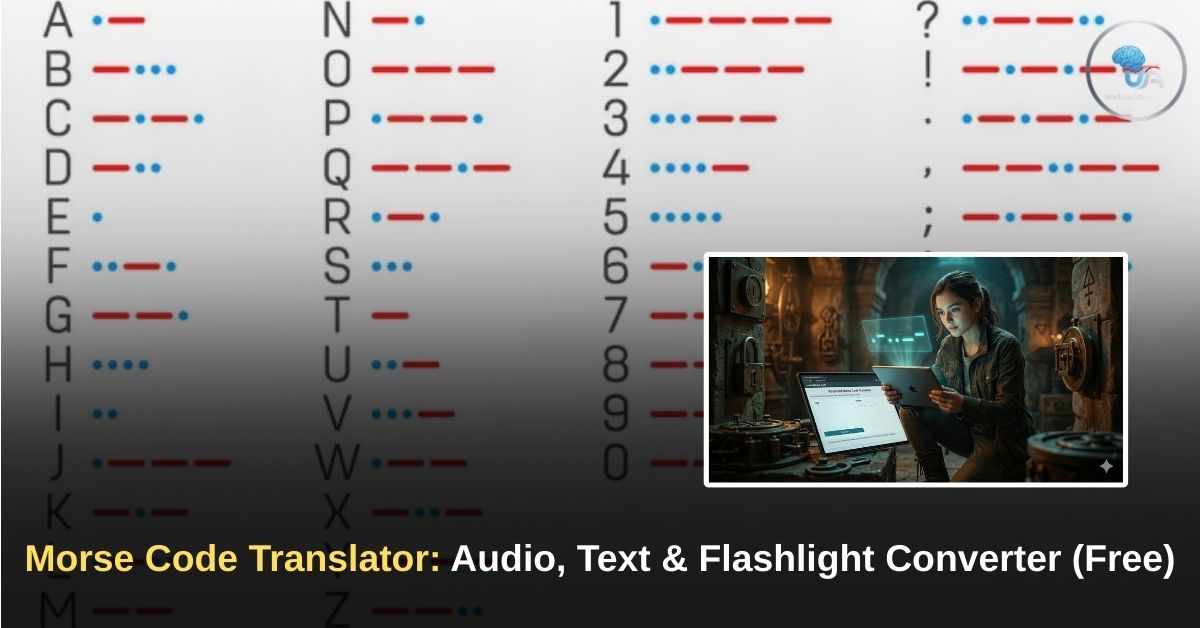
Numbers in Morse code consist of five symbols each and follow a logical pattern. For example, 1 is .----, 2 is ..---, and it progresses up to 5 (.....). Then it reverses, so 6 is -...., leading up to 0 which is five dashes -----.
What does the WPM setting do?
WPM stands for Words Per Minute. It dictates how fast the audio plays. 5 WPM is very slow and ideal for beginners learning to identify individual letters. 20+ WPM is standard conversational speed for experienced radio operators.
Does Morse code support capital letters?
No, there is no distinction between uppercase and lowercase letters in Morse code. A capitalized "A" and a lowercase "a" share the exact same .- translation.