
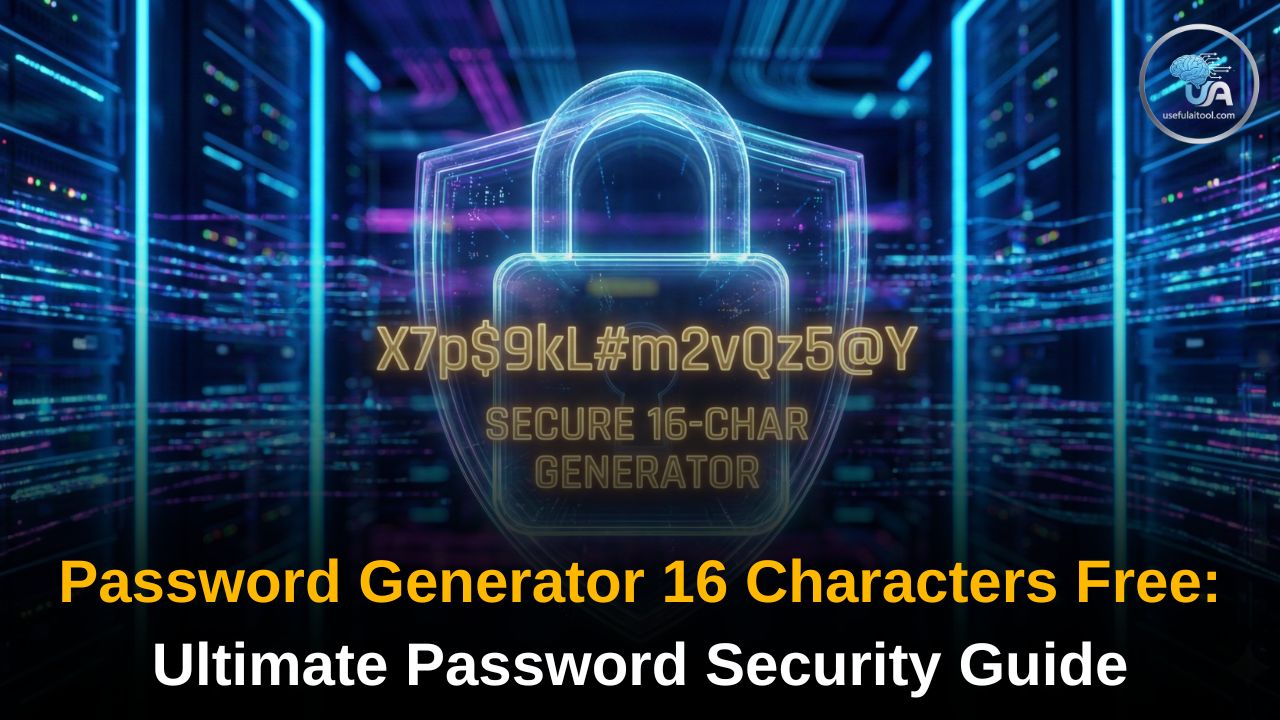
Password Generator 16 Characters Free 2026: In the fast-evolving digital landscape of 2026, the traditional 8-character password is as obsolete as a floppy disk. With AI-driven brute-force attacks becoming faster and more efficient, the way we protect our online banking, social media, and work accounts has shifted. Today, cybersecurity experts and organizations like NIST (National Institute of Standards and Technology) emphasize one primary factor above all else: Length.
Why You Need a Password Generator with 16 Characters (Free & Fast)
You might wonder, “Why exactly 16 characters?” The answer lies in Entropy. Entropy is a measure of randomness. While a 12-character password is “okay,” a 16-character password creates over 100 bits of entropy when mixed with symbols and numbers. This means it would take a modern supercomputer trillions of years to crack it through brute force.
Also Try this Tool: Delhi Circle Rate 2026 Calculator: Calculate Your Property Value and Registration Charges
Our password generator 16 characters free tool is built to provide this high-level security instantly. It generates a completely random string locally on your device, ensuring that not even our servers know your secret code.
NIST 2026 Guidelines: Length Over Complexity
One of the biggest shifts in the 2025-2026 NIST updates is the move away from “forced complexity.” In the past, websites forced you to use one uppercase, one lowercase, one number, and one weird symbol. This often led to predictable patterns like “Password123!” which are actually easy for AI models to guess.
NIST now recommends:
- Prioritize Length: A 16-character simple phrase is stronger than an 8-character complex mess.
- Stop Forced Resets: Unless your account is compromised, changing passwords every 90 days actually makes people choose weaker passwords.
- Accept All Characters: Users should be allowed to use spaces and even emojis in their passwords for higher entropy.
AI-Driven Cyber Attacks: The 2026 Threat Landscape
As we navigate 2026, hackers are no longer just guessing passwords. They are using Generative AI to analyze your social media, personal history, and previous data breaches to “hallucinate” your most likely password.
By using our secure random generator, you remove the human element. A machine cannot guess what a random number generator created. This is your strongest defense against polymorphic malware and automated reconnaissance tools that are currently dominating the dark web.
How to Use This Tool for Maximum Security
To get the most out of our free tool, follow these 2026 best practices:
- 16 Characters is the Minimum: For your primary email or banking, we recommend sliding the tool up to 20 or 24 characters.
- Unique for Every Site: Never reuse the same 16-character password. If one site is breached, all your accounts stay safe if the passwords are unique.
- Use a Password Manager: Don’t try to memorize these! Use a trusted manager to store the passwords generated here.
- Enable MFA/Passkeys: While a strong password is great, 2026 security requires Multi-Factor Authentication as a second layer.
Industry Shift Toward Password-Less Authentication
While strong passwords remain essential today, technology companies are also exploring alternatives. The industry has begun transitioning toward password-less authentication, including the use of passkeys and biometric verification, as part of long-term strategies to reduce reliance on traditional passwords.
Major platforms have expanded support for passkeys, which rely on cryptographic keys stored on user devices rather than memorised passwords. These systems aim to reduce phishing risks and improve user convenience, though widespread adoption remains gradual.
Until such methods become universal, passwords continue to form the foundation of digital identity security, reinforcing the importance of best practices in password creation and management.
Editorial Perspective: Strengthening the First Line of Defence
The renewed focus on free 16-character password generators reflects a broader reality in cybersecurity: many breaches exploit basic weaknesses rather than advanced vulnerabilities. As large-scale credential exposures continue to surface, the importance of strengthening everyday security habits has become increasingly clear. Free password generators offer a low-barrier entry point for improving protection, particularly when combined with password managers and multi-factor authentication. While the future may bring password-less systems, current risks underline the need for stronger credentials as a practical and immediate safeguard.
Growing Concerns Over Credential Exposure
Cybersecurity agencies and independent researchers have reported the presence of vast volumes of compromised login credentials across multiple unsecured databases and malware-harvested repositories. In 2025, a cache estimated at around 16 billion credentials was identified, raising alarms across the digital security ecosystem.
While experts continue to assess the extent of duplication and overlap within these datasets, the disclosures have once again highlighted a persistent issue: weak, reused, and predictable passwords remain a major vulnerability in online security. According to cybersecurity researchers, a significant proportion of successful account takeovers continue to rely on previously leaked credentials rather than sophisticated hacking techniques.
These findings have renewed calls for stronger password practices, particularly among individual users who continue to rely on simple or repeated passwords across multiple platforms.
Why Password Length Has Become Central to Security Advice
Among the various factors that determine password strength, length has emerged as a critical element. Security specialists note that longer passwords dramatically increase the number of possible character combinations, making brute-force attacks — which systematically attempt every possible option — far more time-consuming and computationally expensive.
Experts commonly recommend passwords that are at least 16 characters long, combining uppercase letters, lowercase letters, numbers, and symbols. Such passwords are considered significantly more resistant to automated cracking tools than shorter or pattern-based alternatives.
Cybersecurity firms have emphasised that randomness is just as important as length. Passwords generated through automated tools avoid predictable structures, dictionary words, and personal information that attackers often exploit.
Conclusion
Protecting your digital identity is a continuous process. By starting with a 16-character secure password, you are taking the single most effective step toward cyber-resilience. Use our tool as often as you like—it’s free, anonymous, and built for the security challenges of 2026.
Password Generator 16 Characters Free 2026: FAQs
Q1: Is this 16-character password generator free to use forever?
Yes! Our tool is 100% free and requires no registration. It’s a utility provided by usefulaitool.com to promote digital safety.
Q2: Are the passwords stored on your server?
Absolutely not. The generation happens in your browser’s “Client-Side” memory using window.crypto. Once you close the tab, the password is gone from our end.
Q3: Can a 16-character password be hacked?
Technically, no system is 100% unhackable, but a random 16-character password is “computationally infeasible” to brute-force with current and near-future technology.
Q4: Why does NIST now prefer length over special characters?
Special character requirements often lead to human-predictable patterns. Length exponentially increases the mathematical combinations, making it much harder for AI-driven crackers.




3 thoughts on “The Ultimate Guide to Password Security in 2026: Why 16 Characters is the New Standard”