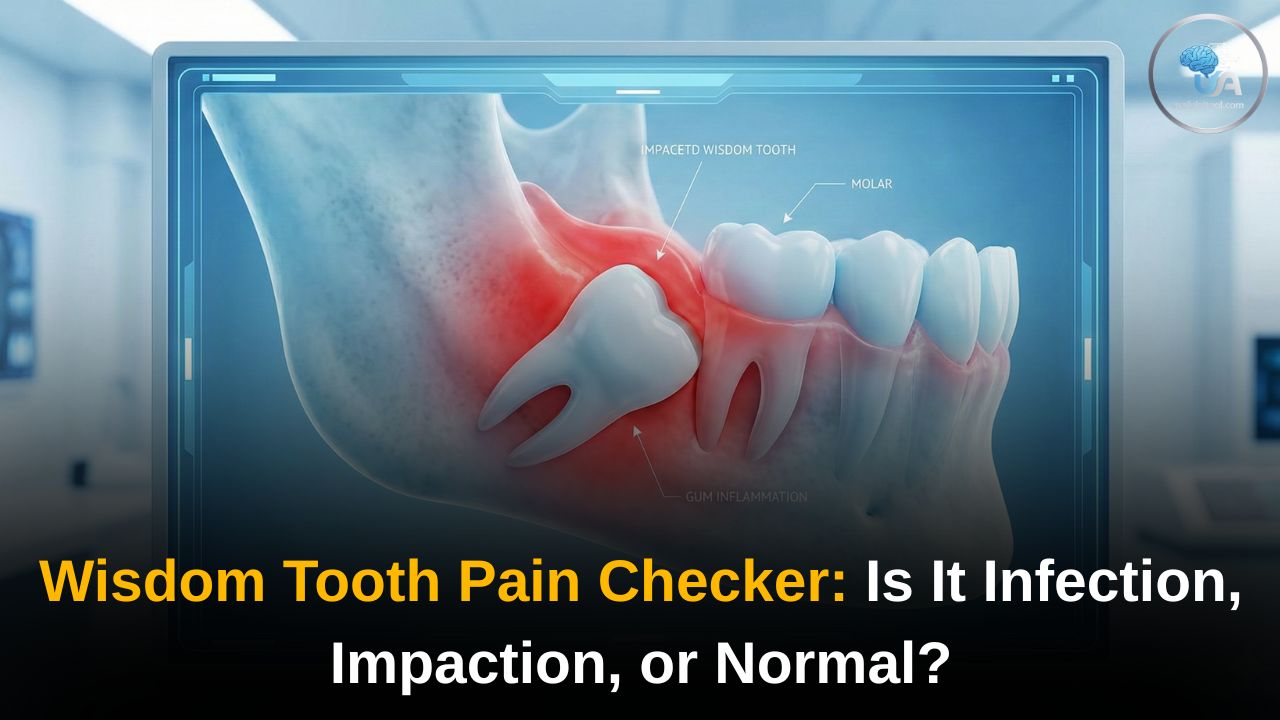
Wisdom Tooth Pain Checker 2026: Wisdom teeth, officially known as “third molars,” are notorious troublemakers. They are the last teeth to emerge, usually between the ages of 17 and 25. By the time they arrive, most people simply don’t have enough room in their jaws to accommodate them.
The result? Pain, swelling, and confusion.
If you are currently holding an ice pack to your cheek at 2 AM, wondering if you need to rush to the emergency room, you are not alone. It can be hard to tell the difference between the normal discomfort of a tooth breaking through the gum and a dangerous infection.
Use our free Wisdom Tooth Pain Checker tool above to triage your symptoms instantly and decide your next step.
How to Use This Wisdom Tooth Pain Checker 2026
We designed this tool to mimic the initial questions a dentist would ask you during a consultation. It helps you categorize your pain level and symptoms into Low, Medium, or High risk.
🦷 Wisdom Tooth Symptom Checker
Answer 5 simple questions to assess your pain.
Step 1: Assess Your Pain Level
Be honest about how much it hurts.
- Mild: It’s annoying, but you can ignore it if you’re busy.
- Throbbing: You feel a pulse in your gum. It’s constant and distracting.
- Severe: You cannot sleep, eat, or concentrate. This usually indicates nerve involvement or pressure.
Step 2: Check for Swelling
Look in the mirror.
- Is the gum tissue around the back tooth red and puffy?
- Is your outer cheek swollen?
- Note: Visible facial swelling is often a sign that an infection is spreading into the soft tissue.
Step 3: Test Your Mouth Opening (Trismus)
Try to open your mouth as wide as possible.
- If you feel resistance or sharp pain that stops you from opening fully, this is called Trismus (Lockjaw). It is a common sign of an infected lower wisdom tooth.
Step 4: Infection Indicators
Are you experiencing a fever? Do you have a metallic or foul taste in your mouth even after brushing? These are classic signs of pus or bacteria buildup.
Try This Tool Also: The Science of Sleep: How an AI Dream Interpreter Can Unlock Your Subconscious Mind
Interpreting Your Results: What Do They Mean?
Once you hit “Analyze Symptoms,” the tool gives you a risk score. Here is what those scenarios actually mean for your dental health.
1. Normal Eruption (Low Risk)
- What is it? Just like a teething baby, “teething” adults feel pain when a tooth cuts through the gum tissue.
- Symptoms: Soreness, mild redness, and an urge to chew on things.
- Action: Keep the area clean. It should resolve in 3-5 days.
2. Pericoronitis (Medium Risk)
- What is it? This is the most common cause of wisdom tooth pain. When a tooth only partially breaks through, a flap of gum tissue (operculum) covers part of the tooth. Food gets trapped under this flap, causing bacteria to breed.
- Symptoms: Swollen gums, bad breath, bad taste, and pain when biting down.
- Action: You need a dentist to clean under the gum flap. Antibiotics may be required.
3. Impaction & Abscess (High Risk)
- What is it? The tooth is stuck (impacted) against the jawbone or the neighbor tooth. It may have formed an abscess (pocket of pus).
- Symptoms: Severe radiating pain (to the ear or neck), fever, swollen face, inability to open the mouth.
- Action: This is a dental emergency. The infection can spread to the neck or airway if untreated.
5 Home Remedies for Instant Wisdom Tooth Relief
While you are waiting for your dental appointment, you can manage the pain at home with these proven methods.
1. The Salt Water Rinse (The Gold Standard)
Salt is a natural disinfectant. It helps draw out infection and reduces gum swelling.
- Recipe: Mix 1 teaspoon of salt into a cup of warm (not hot) water.
- How to: Swish gently around the painful area for 30 seconds and spit. Do this 4-5 times a day, especially after eating.
2. Clove Oil (Natural Anesthetic)
Cloves contain Eugenol, a natural numbing agent used in professional dental materials.
- How to: Dab a small amount of clove oil on a cotton ball and place it gently against the painful gum. Warning: It tastes strong!
3. Cold Compress
If your face is swollen, heat will make it worse. Use Ice.
- How to: Wrap an ice pack in a towel and hold it against your cheek for 15 minutes on, 15 minutes off. This constricts blood vessels and reduces inflammation.
4. Over-the-Counter Anti-Inflammatories
Dentists usually recommend anti-inflammatory medication (like Ibuprofen/Advil) over simple painkillers (like Tylenol) because wisdom tooth pain is caused by inflammation.
- Note: Always check with your doctor before taking new medication.
5. Peppermint Tea Bags
Wet a peppermint tea bag and put it in the freezer for a few minutes. Place the cold tea bag on the gum. The cold numbs the area, and peppermint has mild soothing properties.
When Should You See a Dentist? (Red Flags)
You should not rely on home remedies if you see these dangerous signs. Seek professional help immediately if:
- You have a fever: A temperature over 100.4°F (38°C) indicates the infection is systemic (in your blood).
- You can’t swallow: If swallowing is difficult or painful, the swelling might be blocking your airway.
- Numbness: If your lip, chin, or tongue feels numb, the impacted tooth might be pressing on a nerve.
- Continuous Bleeding: If the gum bleeds without stopping.
FAQ on Wisdom Tooth Pain Checker
Q: Does wisdom tooth pain go away on its own?
Here are the most common questions our users ask about wisdom teeth.
A: If the pain is caused by normal eruption, yes, it will go away in a few days. However, if the pain is caused by impaction or decay, it will not go away. It might fade temporarily but will return more severely as the infection grows.
Q: Do I really need to remove my wisdom teeth?
A: Not everyone does! If your wisdom teeth grow in straight, have enough room, and you can keep them clean, you can keep them. However, 85% of people eventually need them removed because they cause crowding or infection.
Q: Why does the pain get worse at night?
A: When you lie down flat to sleep, more blood rushes to your head. This increased pressure in the sensitive blood vessels of the tooth pulp causes the throbbing sensation to increase. Try sleeping with your head elevated on two pillows.
Q: What is a “Dry Socket”?
A: This happens after you get a tooth pulled. If the blood clot dislodges from the socket, bone is exposed to air. It is extremely painful. To avoid it, do not use a straw or smoke for 72 hours after extraction.
Medical Disclaimer
The information provided by this Wisdom Tooth Pain Checker tool and article is for educational purposes only. It is not a substitute for professional medical advice, diagnosis, or treatment. Dental infections can spread quickly to the neck and brain if left untreated. Always seek the advice of your dentist with any questions you may have regarding a medical condition.