Free CD Calculator Online: When it comes to safely growing your wealth, a Certificate of Deposit (CD) is one of the most reliable financial instruments available. Unlike the volatile stock market, CDs offer a guaranteed rate of return for a fixed period. Whether you are saving for a down payment on a house, a new car, or simply building an emergency fund, knowing exactly how much your money will earn is crucial.
Why We Build Ultimate Free CD Calculator for You?
Instead of dealing with complex math or confusing banking brochures, our interactive tool allows you to instantly forecast your earnings. In this comprehensive guide, we will explore how to use a normal CD calculator, discuss the growing popularity of a 6 month CD calculator, and break down the major differences between daily and monthly compounding frequencies.
What is a Certificate of Deposit (CD)?
A Certificate of Deposit is a type of savings account offered by banks and credit unions. You agree to leave a lump sum of money untouched for a specific period (the “term”), ranging from a few months to several years. In exchange for locking up your funds, the bank pays you a fixed interest rate that is typically much higher than a traditional savings account.
Advanced CD Calculator
Analyze Certificate of Deposit Earnings
At the end of the term, the CD reaches “maturity,” and you receive your initial deposit back, plus all the accumulated interest.
How to Use a Normal CD Calculator
Using our tool is incredibly simple. We designed it to function as a normal CD calculator where you have full control over all custom inputs. Here is how to generate your financial forecast:
- Initial Deposit: Enter the total amount of money you plan to deposit into the account.
- CD Term Length: Enter how many months you plan to lock the money away.
- Annual Interest Rate: Input the Annual Percentage Yield (APY) offered by your bank.
- Compounding Frequency: Select how often the bank applies interest to your account (daily, monthly, quarterly, or annually).
Once you enter these four variables, the tool instantly calculates your Total Interest Earned and your Total Final Balance.
Looking to calculate complex equity returns instead of fixed savings? Check out our Advanced Stock Market Calculator for more investment analytics.
Short-Term Savings: The 6 Month CD Calculator
In an environment where interest rates are frequently changing, many investors are hesitant to lock their money away for 3 to 5 years. This has led to a massive surge in the popularity of short-term certificates.
By utilizing the 6 month CD calculator mode in our tool, you can see exactly how profitable a short-term lockup can be. Often, banks will run promotional high-yield rates specifically on 6-month or 9-month terms to attract new deposits.
A 6-month CD is perfect for:
- Cash you are saving for an upcoming tax bill.
- A wedding fund that you will need to access later in the year.
- Protecting your emergency fund from inflation while keeping it relatively liquid.
The Mathematics of Compounding: Daily vs. Monthly
One of the most overlooked aspects of choosing a CD is the compounding frequency. Compounding is the process where the interest you have already earned starts earning interest of its own.
CD Calculator Compounded Monthly
The most standard offering from credit unions and local banks is monthly compounding. If you select the CD calculator compounded monthly option in our tool, the math calculates your interest payout at the end of every 30-day cycle. This is a steady, reliable growth model.
CD Calculator Compounded Daily
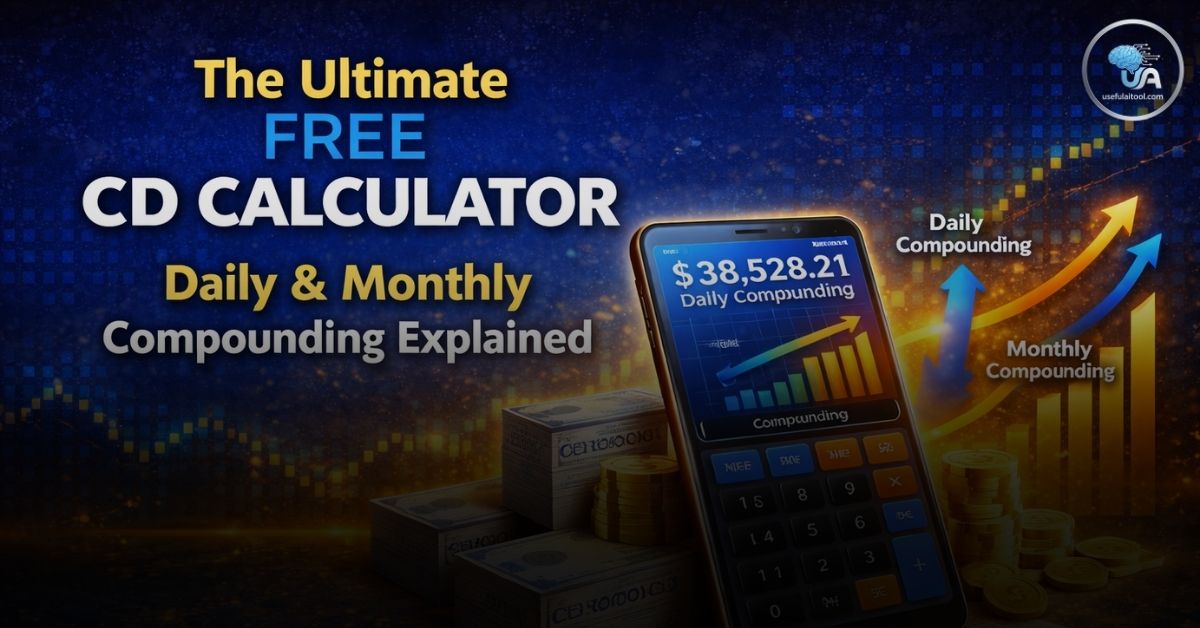
High-yield online banks often use daily compounding. If you select the CD calculator compounded daily option, the bank calculates a tiny fraction of your annual interest every single day and adds it to your principal balance.
Which is better?
Mathematically, the more frequent the compounding, the more money you make. Daily compounding will always yield a slightly higher final balance than monthly compounding, assuming the APY and deposit amount are identical. Our tool allows you to toggle between both options to see the exact dollar-amount difference.
The standard formula our tool utilizes to calculate this is:
$$A = P(1 + \frac{r}{n})^{nt}$$
Where A is the final amount, P is the principal, r is the decimal interest rate, n is the compounding frequency, and t is the time in years.
Comparing Bank Rates
To get the most out of your money, you must shop around. The difference in earnings between a traditional brick-and-mortar bank and an online-only bank can be staggering.
Using a CD Calculator Bank of America (Traditional Banks)
Many people default to opening a CD with their primary checking account provider. However, traditional mega-banks often offer much lower rates on standard CDs. If you select the CD calculator Bank of America preset in our tool, you will notice the interest rate defaults to a very low percentage. While these banks offer unmatched physical convenience and security, their standard CD rates rarely outpace inflation unless you qualify for specific high-balance promotional tiers.
Using a CD Calculator NerdWallet (High-Yield Aggregators)
If you want to maximize your returns, you should research high-yield options on aggregator sites. If you select the CD calculator NerdWallet preset, the tool inputs a much higher national average yield. Online banks (like Ally, Marcus, or Discover) do not have the overhead costs of maintaining physical branches, allowing them to pass those savings onto you in the form of significantly higher CD rates.
You can use aggregator sites to find the best current APY, and then plug that exact number into our free calculator to verify the math before committing your funds.
Important Things to Consider Before Opening a CD
While our calculator shows you the perfect scenario of holding a CD to maturity, there are real-world factors to consider:
- Early Withdrawal Penalties: If you need your money before the CD term expires, the bank will charge you a penalty. This usually equates to sacrificing several months of earned interest, and in severe cases, it can eat into your original principal.
- Inflation Risk: If you lock into a 5-year CD at 3%, and inflation rises to 5%, your money is technically losing purchasing power over time. This is why many investors use a “CD Ladder” strategy (buying multiple CDs of varying lengths) to mitigate risk.
- FDIC Insurance: Always ensure the institution you are banking with is federally insured. You can verify a bank’s status on the official FDIC website.
FAQs on Ultimate Free CD Calculator
Is a CD better than a High-Yield Savings Account (HYSA)?
It depends on your goals. A CD guarantees your interest rate for the entire term, protecting you if national interest rates drop. An HYSA allows you to withdraw your money at any time without penalty, but the interest rate can fluctuate month to month.
Does this calculator account for taxes?
No. The interest you earn on a standard CD is considered taxable income by the IRS. You will receive a 1099-INT form at the end of the year. Our tool calculates your gross earnings before taxes are applied.
Can I add more money to a CD after I open it?
Generally, no. Traditional CDs require a single, upfront lump-sum deposit. If you want to invest more money later, you will need to open a brand new CD at whatever the current interest rate is at that time. (There are rare exceptions called “Add-On CDs,” but their base rates are typically lower).