GDS Best State Predictor 2026-2027: Every single year, millions of ambitious young minds across India look forward to the India Post Gramin Dak Sevak (GDS) recruitment cycle. With hundreds of thousands of vacancies announced across various postal divisions, the opportunity to secure a stable government job straight out of high school is an attractive prospect.
However, beneath the excitement lies one of the most critical decisions an applicant will ever make: “Which state or postal circle should I apply to?”
Choosing the wrong circle can mean competing against an ocean of applicants with near-perfect 100% scores, effectively ruining your chances of selection. Conversely, choosing a strategic circle with lower applicant density can land you a secure government position even with moderate marks.
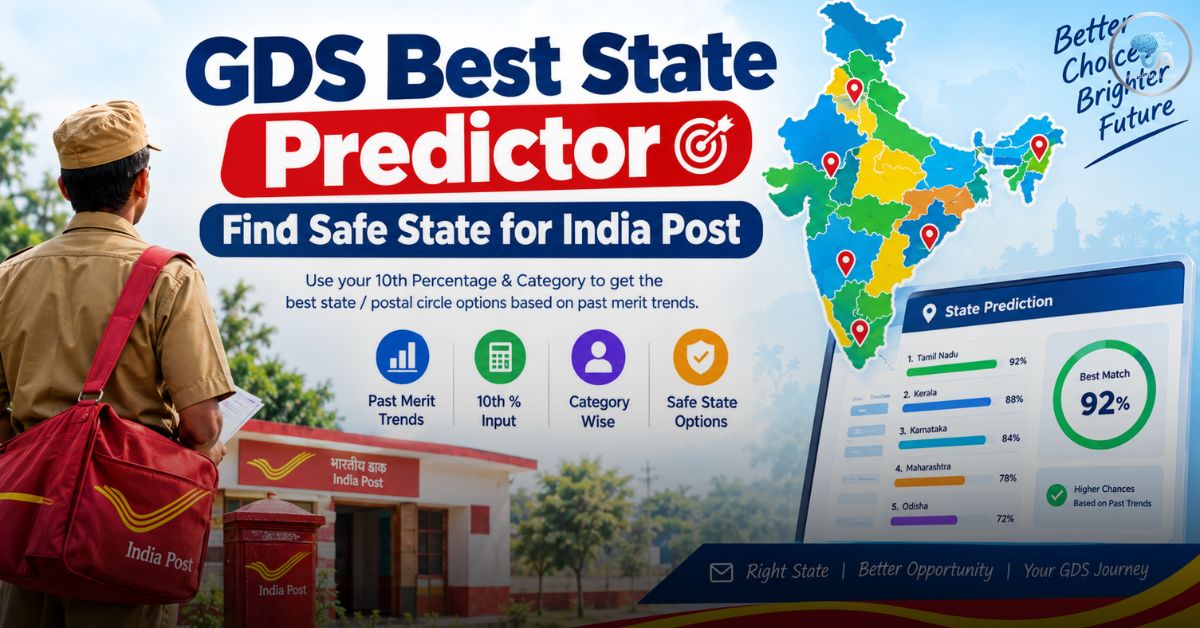
To solve this dilemma, we have built the GDS Best State Predictor 2026 tool directly on our platform. In this comprehensive guide, we will break down how the GDS merit system works, why state selection matters more than your actual board percentage, and how you can use our predictive tool to maximize your recruitment odds.
1. Understanding the GDS Merit Matrix: Why Marks Aren’t Everything
Unlike traditional government examinations (such as UPSC, SSC, or Banking exams) where candidates sit through intensive written tests, India Post GDS selections are made strictly on the basis of merit derived from 10th-grade board examination marks.
GDS Best State Predictor 2026
Analyze your 10th-grade percentage and category to find your safest postal circle.
There are no interviews, no written exams, and no physical tests for initial shortlisting. The automated system simply ranks applicants based on their final aggregate percentage down to four decimal places.
This creates a unique competitive ecosystem:
- The 100% Phenomenon: In recent recruitment cycles, states like Uttar Pradesh, Rajasthan, and parts of Andhra Pradesh have seen cut-offs touch 100% due to grading inflation across various state and central education boards.
- The Regional Disparity: While northern and western circles experience cut-off inflation, remote hill states, tribal belts, and north-eastern postal circles often experience significantly lower merit thresholds.
- Language Proficiency Mandate: India Post requires candidates to have studied the local official language of the chosen postal circle at least up to the 10th standard. You cannot blindly choose a remote state unless you meet their specific linguistic eligibility criteria. For official updates, you can always cross-check guidelines directly on the official India Post Engagement Portal.
Factors That Influence GDS Cut-Offs in 2026
When our GDS Best State Predictor 2026 engine evaluates your profile, it runs your input through a multi-variable analysis matrix. Understanding these core factors will help you make an informed career move:
A. Total Vacancy Volume vs. Applicant Density
Some states release thousands of Branch Postmaster (BPM) and Assistant Branch Postmaster (ABPM) vacancies, which initially attracts applicants. However, high-density states also attract applicants from neighboring states who happen to fulfill the language requirement, driving cut-offs sky-high.
B. Category-Wise Seat Distribution
Reservation policies play a vital role. The competition level for Unreserved (UR) seats is fierce, often requiring upwards of 95% to 98% in most popular circles. Meanwhile, reserved categories (OBC, SC, ST, EWS) experience varied cut-off curves depending on local demographic saturation.
C. Board Grading Variations
Different education boards evaluate students differently. CBSE and ICSE students compete directly against state board students who may have received generous grading. This structural imbalance makes selecting a balanced regional circle vital for survival in the merit list.
Step-by-Step: How to Use the GDS Best State Predictor Tool
Our interactive tool is designed to take the guesswork out of your application process. If you want to optimize your application strategy in under 30 seconds, follow these simple instructions:
- Step 1: Access and Theme Setup: Scroll up to the GDS Best State Predictor 2026 tool interface on this page. If you prefer a lighter or darker background, click the quick toggle button in the top right corner.
- Step 2: Enter Your 10th Percentage: Input your exact high school aggregate percentage score (e.g.,
89.5or94.2). Ensure the value falls within the standard 33% to 100% range. - Step 3: Select Your Category: Choose your correct reservation profile from the drop-down selector (UR, OBC, EWS, SC, or ST). This allows the tool to adjust cut-off volatility matching your specific seat pool.
- Step 4: Run the Simulation: Click the Predict Best Safe States button. The application will instantly render a customized analytical output card displaying your recommended safe, moderate, and high-probability postal circles.
(Looking for more tools to optimize your daily productivity or planning? Don’t forget to check out our popular Useful AI Sleep Calculator to fine-tune your circadian rhythm and rest routine after study hours!)
Strategic Breakdown: Target Circles by Score Range
Depending on where your high school marks land, your target strategy should change significantly:
For High Scorers (95% and Above)
If you are sitting on an elite high school percentage, you have the flexibility to target competitive northern and central zones like Uttar Pradesh, Bihar, Delhi, and Rajasthan. However, even with high marks, checking alternative circles can protect you against unexpected cut-off spikes.
For Moderate Scorers (85% to 94%)
Students in this bracket should look toward balanced regional circles like Maharashtra, Gujarat, West Bengal, and Madhya Pradesh. These zones offer a healthy mix of vacancy volume and moderate cut-off margins, giving you a strong fighting chance.
For Developing Scorers (Below 85%)
If your board score falls below the 85% threshold, targeting high-density mainland states can lead to disappointment. Your safest bet lies in exploring remote divisions within the North-Eastern Postal Circle (such as Assam, Meghalaya, or Tripura) or specialized hinterland terrain divisions where applicant density is lower. Always verify local language criteria before applying to these regions.
Frequently Asked Questions (FAQs)
Q: Can I apply to multiple states simultaneously in the 2026 GDS recruitment?
A: No, India Post typically allows a candidate to apply for a single selected division or circle per recruitment cycle using their registration details. Choosing your target state carefully on the first try is essential.
Q: Does the GDS Predictor guarantee selection?
A: The tool uses historical recruitment trends, category distributions, and cut-off projections to calculate your safest statistical zones. It serves as an advanced advisory utility to guide your application strategy rather than an official government guarantee.
Q: What happens if I get shortlisted?
A: If your name appears in the merit list, you will be called for document verification at the designated divisional head office, where your original 10th marksheet, category certificates, and linguistic proofs will be thoroughly verified.
Conclusion: Take Control of Your Career Path Today
Applying for India Post GDS 2026 doesn’t have to be a blind gamble. By analyzing your academic score, understanding regional cut-off realities, and leveraging data-driven insights, you can place your application in the safest possible zone.
Head back up to the GDS Best State Predictor 2026 tool right now, plug in your marks, and discover your optimal postal circle in seconds!