Savings vs. CDs: In the current financial landscape of 2026, savers are facing a unique set of opportunities. After years of fluctuating interest rates, the market has finally settled into a “higher-for-longer” environment. For the average person with extra cash sitting in a standard checking account, this is a call to action. You are effectively losing money every day to inflation if your savings aren’t working for you.
The two most popular “safe-haven” investments for cash today are High-Yield Savings Accounts (HYSAs) and Certificates of Deposit (CDs). Both are typically FDIC-insured, meaning your principal is safe up to $250,000. However, they serve very different financial purposes.
In this comprehensive guide, we will break down the pros and cons of each, analyze the 2026 interest rate trends, and help you decide where to park your money for maximum growth.
What is a High-Yield Savings Account (HYSA)?
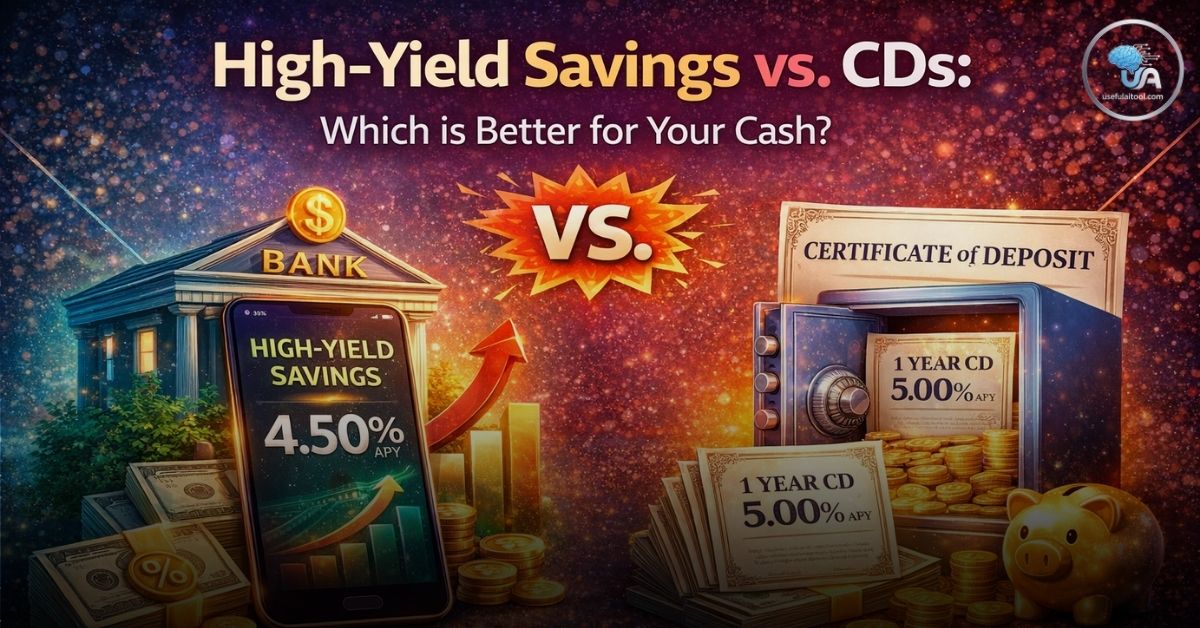
A High-Yield Savings Account is exactly what it sounds like: a savings account that pays a significantly higher interest rate than a traditional brick-and-mortar bank. While a standard big-bank savings account might pay a dismal 0.01% APY, a top-tier HYSA in 2026 can offer anywhere from 4.00% to 5.00%.
The Pros of an HYSA
- Liquidity: This is the biggest advantage. You can deposit and withdraw your money almost whenever you need it (usually limited to 6 withdrawals per month by federal regulation).
- Safety: Your money is liquid and insured, making it the perfect “Emergency Fund” vehicle.
- Compound Interest: Most HYSAs compound interest daily or monthly, allowing your balance to grow faster over time.
The Cons of an HYSA
- Variable Rates: The interest rate is not “locked.” If the central bank decides to lower national interest rates, your bank will lower your HYSA rate almost immediately.
- Temptation: Because the money is easy to access, you might be tempted to spend it on non-emergencies.
What is a Certificate of Deposit (CD)?
A Certificate of Deposit is a “time deposit.” You agree to leave your money with the bank for a fixed period—ranging from 3 months to 5 years. In exchange for this commitment, the bank usually gives you a higher interest rate than a savings account.
The Pros of a CD
- Guaranteed Rate: Once you open a CD, your interest rate is locked for the entire term. Even if the economy crashes and rates plummet, your 5.2% CD will keep paying 5.2%.
- Discipline: Because there is a penalty for early withdrawal, it forces you to keep your hands off your long-term savings.
- Predictability: You know exactly how much money you will have on the day the CD matures.
To see exactly how much you can earn with different terms and rates, use our Free CD Calculator to model your 6-month or 1-year returns.
The Cons of a CD
- Lack of Liquidity: Your money is “stuck.” If you need that cash for a sudden emergency, you will have to pay an early withdrawal penalty, which often wipes out several months of interest.
- Inflation Risk: If you lock in a 1-year CD at 4%, but inflation jumps to 6%, your “real” return is actually negative.
2026 Comparison Table: HYSA vs. CD
| Feature | High-Yield Savings (HYSA) | Certificate of Deposit (CD) |
| Interest Rate | Variable (Can change anytime) | Fixed (Locked for the term) |
| Access to Cash | High (Withdrawals allowed) | Low (Early withdrawal penalties) |
| Best For | Emergency funds / Short-term | Specific goals / Planned spending |
| Risk Level | Low (FDIC Insured) | Low (FDIC Insured) |
| 2026 Average APY | 4.10% – 4.50% | 4.75% – 5.50% |
The 2026 Market Outlook: Why 6-Month CDs are Winning
As of March 2026, we are seeing an “inverted yield curve” in the CD market. This means that 6-month and 1-year CDs are often offering higher interest rates than 5-year CDs. Banks are currently hungry for short-term liquidity, making it a “golden age” for short-term savers.
If you have money that you know you won’t need for the next half-year—perhaps for a wedding, a down payment, or a planned vacation—the 6-month CD is currently the most efficient way to maximize your yield without the long-term commitment of a 5-year bond.
Calculate your potential short-term gains instantly with our 6-Month CD Calculator.
How to Decide: Which is Right for You?
Choosing between these two isn’t about which one is “better” globally; it’s about which one is better for your specific goal.
Use a High-Yield Savings Account IF:
- It is your Emergency Fund: You should always have 3–6 months of living expenses in a liquid HYSA before you even think about opening a CD.
- You are saving for an uncertain date: If you are looking to buy a house but haven’t found the right one yet, keep that cash liquid.
- You think rates will go UP: If you believe interest rates will rise in the next few months, an HYSA allows you to “ride the wave” upward.
Use a Certificate of Deposit IF:
- You have a “Known Date” goal: If you know you need $20,000 for a house closing in exactly 12 months, a 1-year CD is the perfect choice.
- You think rates will go DOWN: If you suspect the central bank will cut rates soon, opening a CD now “locks in” today’s high rates for the future.
- You have “Lazy Cash”: If you have extra money sitting in a zero-interest checking account and you have already funded your emergency savings, put that lazy cash to work in a CD.
The Professional Strategy: “CD Laddering”
If you can’t decide, why not do both? Many professional investors use a strategy called CD Laddering.
Instead of putting $50,000 into one 1-year CD, you split the money:
- $10,000 in an HYSA (Liquid)
- $10,000 in a 3-month CD
- $10,000 in a 6-month CD
- $10,000 in a 9-month CD
- $10,000 in a 12-month CD
As each CD matures, you have the option to take the cash if you need it or reinvest it into a new 1-year CD. This gives you a constant stream of “matured” cash every three months while still capturing the higher interest rates of the CD market.
Final Verdict
In 2026, the winner is the person who pays attention. Whether you choose the flexibility of a High-Yield Savings Account or the guaranteed payout of a CD, the most important thing is that you stop leaving your money in accounts that pay nothing.
Take five minutes today to evaluate your cash. Use the tools available on the Useful AI Tool homepage—from our Stock Market Calculator for your riskier investments to our CD Calculator for your safe ones—to ensure every dollar you earn is working as hard as you do.
Summary Checklist for 2026:
- Audit your checking account: Move anything over your monthly expenses into an HYSA.
- Define your goals: For any goal 6+ months away, check current CD rates.
- Lock it in: If you find a rate above 5% APY, consider locking it in with a CD before the market shifts.
- Verify Insurance: Always ensure your chosen bank is FDIC or NCUA insured.
Ready to explore more? Use our AI Story Generator to relax after your financial planning, or check your relationship vibe with our AI Love Calculator. At Useful AI Tool, we provide the digital utilities you need for every part of your life.